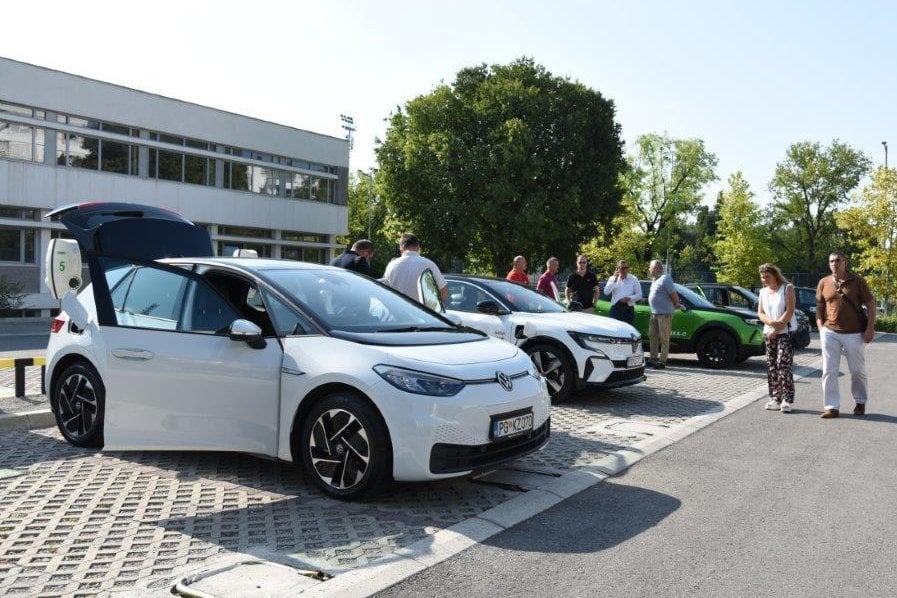

Ahead of World Electric Vehicle Day, observed on 9 September, the Business Improvement and Innovative Technologies Sector, in cooperation with CIRED Montenegro, organised a presentation of the electric vehicles and charging stations owned by CEDIS on 8 September in the car park of the CEDIS Administration Building. The event was also attended by our company’s business partners, who displayed several electric vehicles. Alliance d.o.o. presented the Renault Megane E-Tech and Dacia Spring, while Osmanagić Co. presented the Opel Mokka. With their striking design, visual features and interiors, the vehicles on display attracted the attention of those present.
In addition to CEDIS employees, representatives of several municipal companies and business organisations attended the event. They had the opportunity to gain further knowledge about e-mobility and all aspects of the concept in an interactive way, including energy efficiency and environmental protection, as well as to test the vehicles and experience the technology of the future.

Those present were welcomed by Dušan Boričić, Head of the Business Improvement and Innovative Technologies Sector, who noted, among other things, that CEDIS, as a company whose core activity is the distribution of electricity, had recognised the trends in the development of e-mobility and the transport of people and goods in good time. Accordingly, a charging station for electric vehicles was purchased and installed in the car park by the Administration Building in 2019. At the same time, three electric vehicles were purchased, marking the beginning of the implementation of the e-mobility concept at our company. The real-world data collected on the use of electric vehicles, relating to the cost-effectiveness of their operation, supported the continued implementation of this idea, which has become viable and practical, as electric vehicles are gradually becoming part of our everyday lives and changing the world.
As for the infrastructure for “refuelling” electric cars, CEDIS currently has a total of six charging stations, each with a capacity of 22 kW. The chargers belong to the so-called smart category, as they include software and an application for monitoring and control. At any time, an authorised user can access a charger and check whether it is available or in use. The chargers can be controlled through the software; for example, a vehicle collection time can be set, and the software communicates with the vehicle to determine the charging power needed to meet the requirement. The software also enables users to monitor the operation of the charging station at any time, including its charging power and other details.

The software was demonstrated in the car park while three different vehicles were charging: a VW e-Golf, a first-generation vehicle with a charging capacity of 7 kW AC; a VW ID.3, a second-generation vehicle with a charging capacity of 11 kW; and a Renault Megane E-Tech with a charging capacity of 22 kW. The software displayed their charging power and showed that charging starts at around 60 per cent of the nominal capacity, while the charger supplies the vehicle’s inverter with full nominal power only after several minutes.
[envira-gallery id=”15521″]
Following the electric vehicle presentation, a panel discussion for our employees on “An Overview of the Historical Development of Electric Vehicles” was held at the Centre for the Development of Specialist Competencies.
Opening the panel, Dušan Boričić stressed that electric vehicles are gaining momentum in strong economies, namely in EU countries and China.

“Although we are marking Electric Vehicle Day, the ‘fuel’ that powers them also deserves attention. The ‘fuel’ for electric vehicles is electricity, and CEDIS is responsible for its distribution. CEDIS should focus on charging stations, because sooner or later they will all be users of the distribution network,” said Boričić, who raised several questions relating to e-mobility. Miodrag Janičić, Head of the E-Mobility Service, then delivered a presentation for our employees on “An Overview of the Historical Development of Electric Vehicles.”

Our colleagues actively joined the discussion. Miroslav Stanišić was particularly interested in whether CEDIS would limit its involvement in e-mobility to purchasing vehicles for its own needs, or whether it would also extend its activities externally within the legal framework. A comparison of the energy efficiency of internal combustion engines and electric motors shows that electric motors are 100 per cent more efficient: the efficiency of internal combustion engines is around 30 to 40 per cent, while that of electric motors is around 90 per cent.
As the scheduled time for the panel was gradually running out, many questions remained unanswered. It was therefore agreed that panels of this kind would also be organised in the future, with the participation of representatives from the professional and scientific communities.

The Business Improvement and Innovative Technologies Sector would like to thank the participants in the presentation and panel, and especially CIRED Montenegro, which continually promotes the advancement of professional and scientific competencies, particularly in the field of distribution networks. This makes its close cooperation with CEDIS a natural fit.