
Before responding factually to the malicious criticism by the Deputy Mayor of Tivat, Andrija Petković, we are obliged to explain who is responsible for what in the energy sector.
Expecting public officials who perform responsible duties to be informed at least as much as “ordinary” citizens of both Tivat and Montenegro, we wish to inform Mr Petković that EPCG is not responsible for the electricity distribution network and therefore is not responsible for outages on that network. We also advise Mr Petković, since he feels entitled to speak about the energy companies’ management “warming their seats,” about those people’s honour and their professional competence, that he would do better to look after his own seat, which does not appear to be the result of brilliant knowledge and skill.
To ensure that the public is correctly informed, Elektroprivreda Crne Gore is an electricity producer and supplier, while CEDIS is the company responsible for the electricity distribution network.
Now that we have clarified this, let us proceed.
The aforementioned interruptions to the electricity supply in the Municipality of Tivat began on Friday, 24 May 2024, at 13:08. The outage was caused by construction machinery, which severed two 35 kV cables while work was being carried out on the local road to the village of Tripovići. The two cables in question, Tivat 1 and Tivat 3, are located along the “TS 110/35 kV Tivat (Gradiošnica) – TS 35/10 kV Tivat” cable route and consist of seven cable cores laid in the same trench. Following the disconnection of the Gradiošnica–Tivat–Opatovo 35 kV overhead line, on the order of the Electricity Inspectorate due to the danger posed by its route, these cables constitute the only connection—and a double one—to the TS 35/10 kV Tivat substation, which is vital for supplying customers in the Municipality of Tivat. We emphasise that any cable damage causes permanent deterioration and reduces its reliability, regardless of the intervention by our crews, resulting in further consequential faults along the cable route.
The 20 kV and 35 kV Maintenance Sector maintains the existing electricity infrastructure under its responsibility, and the situation that arose determined the subsequent actions of the Sector’s operational crews. Urgent measures were taken to determine the extent of the damage and engage subcontractors to carry out the physical work of excavating the cable trench.
After inspecting the severely damaged cable route, the crews on site were forced to use almost 30 metres of cable and install as many as 14 cable joints in order to repair the damage (see attached Photo 1). Following final testing and phasing, the supply was restored at 20:14.

Thus, the fact that both cable circuits, including the reserve core, were severed by construction machinery used by contractors engaged by the Municipality of Tivat, the project investor, shows the nature of the attack on our existing infrastructure (see attached Photo 2).

The fact that the Gradiošnica–Tivat–Opatovo 35 kV overhead line has been out of service since 2015, by order of the Electricity Inspectorate, illustrates the threat to both the overhead and underground electricity infrastructure owned by CEDIS in this area. On 11 June 2024, the competent department once again inspected the route of this overhead line, which once provided an alternative supply to the TS 35/10 kV Tivat substation, and confirmed that the line is so endangered that, at some points along its route, newly built residential structures are only 40–50 cm from the conductors—below all prescribed minimum safety clearances for this voltage level (see attached Photos 3, 4, 5 and 6).


We ask: in this situation, where buildings have been constructed without authorisation in the Municipality of Tivat, is it possible to operate the existing overhead line? And who could energise this overhead line without endangering the lives of people in the area?
During the summer, due to the increased number of customers in the Municipality of Tivat and the resulting rise in network load, both cable circuits, Tivat 1 and Tivat 3, must be in service. Any negligence in the work zone along this cable route therefore causes problems with the electricity supply to customers.
We are also providing data on the loads during the summer months, which cause problems on the network and explain why both cables are needed to supply Tivat.
Regarding the load, the TS 35/10 kV Porto Montenegro substation, supplied via the TS 35/10 kV Tivat substation—that is, via the two 35 kV cables mentioned above—has recorded no increase in load over the past three years, but has reached a maximum of just over 5 MW throughout this period. The average demand has ranged from 2.56 MW to 2.73 MW. A certain increase in load has been observed at the TS 35/10 kV Tivat substation, from a maximum demand of 13.54 MW in 2021 to 15.92 MW in 2023.
Both cables supplying the TS 35/10 kV Tivat substation are type XHP 48 240 mm², with a maximum permissible continuous load of 541 A, or approximately 32 MW. This means that one cable alone is more than sufficient to meet the needs of the TS 35/10 kV Tivat and TS 35/10 kV Porto substations, including in the future. The second cable can be used as needed and, under the standard switching configuration, operates in parallel to meet the “n-1” reliability criterion. However, given the numerous cable damages caused by third-party negligence and the many joints installed, these cables must not be loaded anywhere near their maximum permissible current. The current protection settings on these lines (first-stage overcurrent protection, i.e. overload protection) are 270 A and 300 A, respectively.
This is not the first time this cable route has been exposed to the actions of negligent members of the public. It has been established countless times that the designated position of the cable route has been compromised by earth being deposited or removed along the line, and even by the cables being completely exposed and brought to the surface. For this reason, CEDIS has reported the threat to the competent inspectorate on several occasions (see attached Photos 7, 8 and 9).


A case from several years ago, when the cable in question at KO Mrčevac was endangered and had to be relocated, but approval for construction from the municipal authorities of the Municipality of Tivat was delayed for a long time, speaks volumes about the objective challenges our company faces (see attached Photos 10 and 11).


No one benefits from such undesirable situations, which cause interruptions to the electricity supply, least of all our company. We continuously call on investors to exercise a high degree of responsibility in construction work zones, to observe the register of underground utilities and, whenever there is any uncertainty, to contact the competent department. The department’s contact details are provided to the investor so that any doubts can be resolved on site. We also urge particular care to be taken to observe the clearly visible cable route markers, which indicate that an electricity cable has been laid along the marked route (see attached Photo 12).

We do not believe it is fair to point the finger at our company and seek to place the blame at its door when all our employees do their utmost to prevent such problems, while CEDIS operational crews make superhuman efforts to restore endangered and damaged electricity infrastructure to operational readiness.
We believe that all competent institutions in our community should contribute to enabling CEDIS to continue working in the interests of its customers. A prerequisite is protecting existing infrastructure from irresponsible damage and ensuring that investment projects can be implemented without hindrance—projects whose implementation is obstructed by lengthy procedures for obtaining all the required permits and approvals.
The claims that no investment is being made in Tivat’s distribution network and that, as Mr Petković says, “the system dates back to 1965, so it is clear even to a layperson that it cannot withstand the investment boom and meet Tivat’s new needs” are also highly tendentious.
CEDIS is just one link in a chain that must be fully connected in order to meet all the prerequisites for constructing an electricity facility. In addition to CEDIS, the process involves the competent institutions, such as municipalities, ministries, the Real Estate Administration, cadastral authorities, as well as legal entities and individuals.
Ultimately, investment implementation depends to a great extent on the pace at which property-law matters are resolved, which is usually the biggest challenge.
The processes that must be completed to construct and energise an electricity facility in accordance with the current Law on Spatial Planning and Construction of Structures are quite lengthy and complicated.
In addition to all the factors mentioned above that make matters more difficult, the situation with the Municipality of Tivat is twice as challenging, as cooperation with the competent institutions in Tivat is extremely difficult. Here are a few examples:
– There are long delays in issuing Urban-Technical Conditions, i.e. Location Decisions (the average wait for a response is approximately six months).
– Processes are made more complicated even when there is no need to do so. One example is the application of Article 74 of the Law on Spatial Planning and Construction of Structures, where, even after lengthy correspondence, we are forced to obtain Location Decisions instead of Urban-Technical Conditions for the construction of electricity infrastructure, thereby making the construction process more complicated.
– There is a case where a building permit was issued for a facility. In response to CEDIS’s enquiry, the Municipality did not extend it, and when we applied again for a building permit, we were told that the documentation was not in order, even though a building permit had previously been issued for the same documentation.
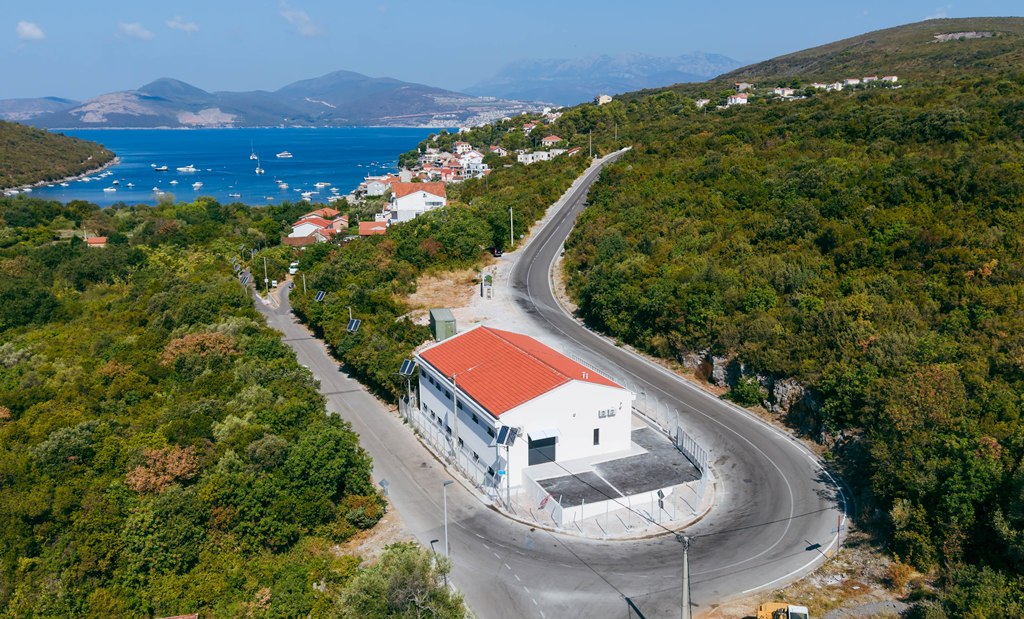
However, despite these difficult circumstances, over the previous period (three years) we have invested approximately €283,700 in electricity infrastructure. Work is under way on 37 investment projects with a total value of approximately €5 million. We would particularly like to note that we have signed a contract for the construction of the TS 35/10 kV Tri Krsta substation on Luštica, with a value of approximately €1.5 million. In the coming period, we plan to launch activities to construct the TS 35/10 kV Tivat 3 substation and integrate it into the 10 kV and 35 kV networks, as well as to build a 35 kV underground line from the planned TS 35/10 kV Tivat 3 substation to the Opatovo switching station. Analyses are also being carried out on the feasibility of replacing the two 8 MVA transformers at the existing TS 35/10 kV Tivat-Centar substation with two 12.5 MVA transformers.