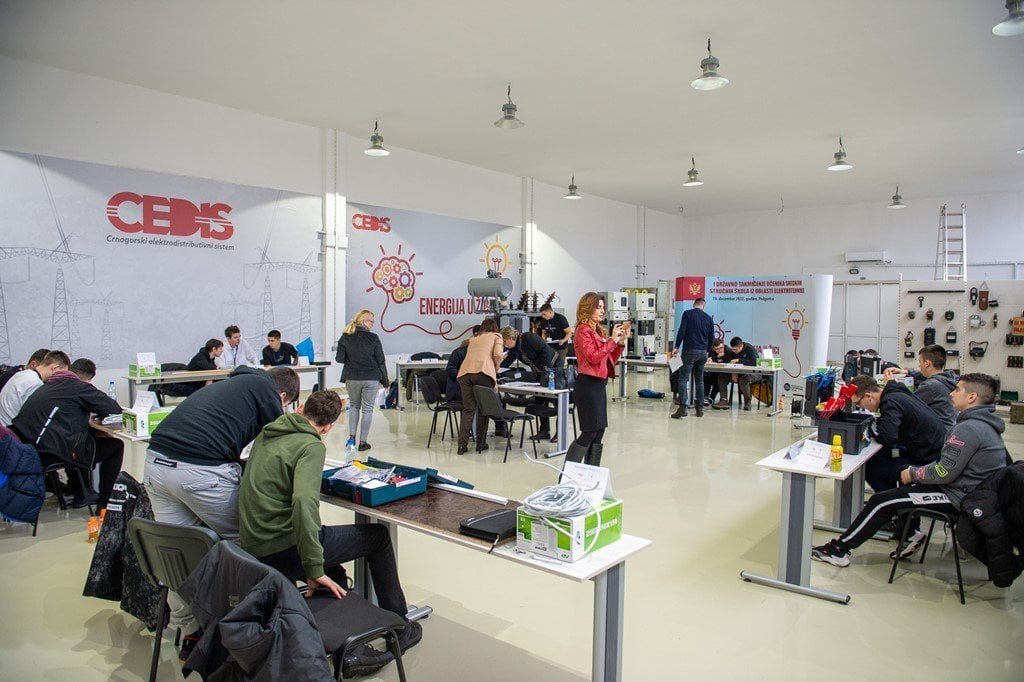
First place at the State Competition for students of Montenegrin secondary schools in the field of electrical engineering, “ENERGY IN THE WIRE,” and a cash prize of 750 euros went to the team from Vaso Aligrudić Secondary Electrical Engineering School in Podgorica.

Vaso Aligrudić Secondary Electrical Engineering School, Podgorica
Teams of three from seven educational institutions offering courses in electrical engineering tested their knowledge and skills (Secondary Vocational School in Berane, Vaso Aligrudić Secondary Electrical Engineering School in Podgorica, Secondary Vocational School in Nikšić, Secondary Vocational School – Pljevlja, Secondary Electrical and Economics School in Bijelo Polje, Secondary Vocational School in Rožaje and Mladost Secondary Mixed School in Tivat).

Second place and a cash prize of 600 euros went to the team from Mladost Secondary Mixed School in Tivat, while third place and 450 euros were won by the team from JU Secondary Electrical Engineering School – Bijelo Polje. The award for the best individual, worth 250 euros, went to Miloš Milićević from Vaso Aligrudić Secondary Electrical Engineering School, while the award for the best school, including a laptop, went to Vaso Aligrudić Secondary Electrical Engineering School. Prizes of 250 euros were also provided for the mentors of the winning teams.
 Miloš Milićević
– We prepared for the competition for more than a month. The tasks were demanding, but we started in time and won. The competition was strong and we are truly satisfied, said Ratko Laković from the first-place team.
– It was an honour to take part in this competition. Thank you to CEDIS for the fantastic atmosphere. We are happy with second place, but we will do our best to perform even better next year, said David Labović, a student at Mladost Secondary Mixed School in Tivat and a member of the second-place team.
 Mladost Secondary Mixed School in Tivat
Ibrahim Avdić from the third-place team, representing the Secondary Vocational School in Bijelo Polje, said that he was pleased with the result, having represented his town, school and country, and that they would strive to do even better next year.
The competitors’ knowledge and skills were assessed by two three-member expert juries, one for the theoretical and the other for the practical part of the competition. The theoretical part was judged by Sandra Brkanović and Slavica Jovanović from the Centre for Vocational Education and Professor Aldin Kajević from the Faculty of Electrical Engineering. The practical part was assessed by Melanija Ćalasan and Veselin Pićurić from the Association of Electrical Engineering Teachers, and Vladimir Ivanović, Head of CEDIS’s Operations Directorate.
It is particularly important to note that, starting this year, the electrical engineering competition “Energy in the Wire” has been included among the official state competitions. This is a clear indication of the quality of the work and the well-conceived idea that CEDIS has been implementing for three years. The previous three competitions were successfully organised by the Association of Electrical Engineering Teachers of Montenegro (UNECG) together with the Montenegrin Electricity Distribution System (CEDIS), with the support of the Centre for Vocational Education.
[envira-gallery id=”14280″]
The event was opened by Vladimir Čađenović, CEDIS Executive Director, and Duško Rajković, Director of the Centre for Vocational Education.
– We consider corporate social responsibility to be one of the most important aspects of our work, and one of the projects we are particularly proud of is the “Energy in the Wire” competition. I am sure that the opportunity to demonstrate and test their acquired knowledge through practical work means a great deal to young people. Over the past three years, we have strived to make the competition high-quality and recognised by the professional community as the best in this field. Our efforts have not been in vain. As you have heard, this year “Energy in the Wire” was granted the status of a state competition. This brings with it even greater significance and responsibility.

We believe that close cooperation between companies and educational institutions significantly enhances young people’s competencies, and Energy in the Wire is an excellent example of productive cooperation between the business and education sectors – said Čađenović at the opening of the competition.
Rajković noted that practical training is a very important part of education, and that the business sector also plays a significant role in it.
– The business sector defines professional competencies through occupational standards, which students are expected to attain through the learning outcomes of educational programmes. The development of electrical engineering, and especially the energy sector, is one of Montenegro’s priority strategic development goals. For us, as representatives of educational institutions, this entails a responsibility towards future generations and requires us to keep up with trends, develop new qualifications and properly guide young people—that is, to create a skilled workforce that will contribute to the development of the country as well as the European economy. We are extremely pleased with our cooperation with CEDIS and with this competition’s transition to state status. We hope that other businesses will follow CEDIS’s example of social responsibility, demonstrated through its focus on vocational education and cooperation with the system’s educational institutions, said Rajković.
Veselin Pićurić, President of the Association of Electrical Engineering Teachers, praised CEDIS for its perseverance in supporting and sustaining this competition.
– CEDIS is the only company in this region to recognise that the skills secondary vocational school students need are, in fact, precisely what the company needs to operate its system. This is why the idea for the Energy in the Wire competition came about four years ago. In addition to being extremely beneficial for young people, this competition also benefits CEDIS, because these students are the company’s future workforce and will apply all these skills in their work. The energy sector is Montenegro’s future, and the more we invest in it, the more we will prosper as individuals and as a country as a whole, concluded Pićurić.