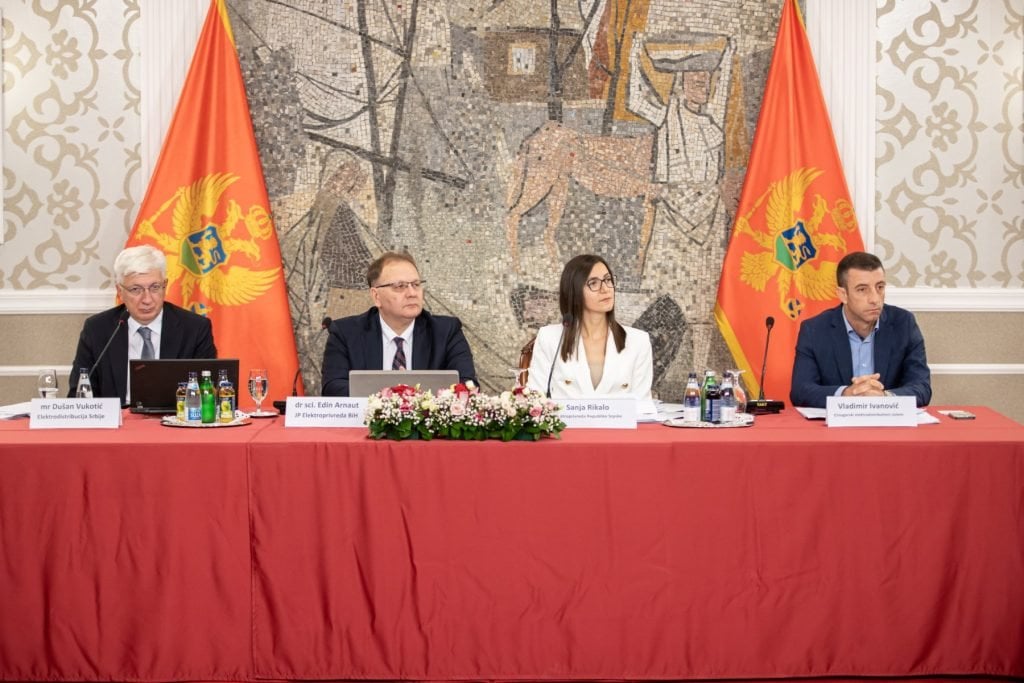

A round table on the topic “Challenges Facing Distribution System Operators in Light of the Energy Crisis” was held today at Villa Gorica, organised by the Montenegrin Electricity Distribution System to mark the Company’s seventh anniversary. Participants shared their insights on this important topic for distribution system operators: Sanja Rikalo, Director of the Distribution System Operator Affairs Directorate at Elektroprivreda Republike Srpske; Dušan Vukotić, Senior Business Process Management Analyst for DEES at Elektrodistribucija Srbije; Dr Edin Arnaut, Director of Elektrodistribucija Zenica, JP Elektroprivreda Bosne i Hercegovine; and the host’s representative, Vladimir Ivanović, Head of the Operations Directorate, who also moderated the event. Also in attendance were the Prime Minister of Montenegro, Dritan Abazović; CEDIS Executive Director Vladimir Čađenović; Chairman of the Board of Directors of Elektroprivreda Crne Gore Milutin Đukanović; and State Secretary at the Ministry of Capital Investments Admir Šahmanović.

Prime Minister Dritan Abazović welcomed the round-table participants, congratulated CEDIS on its seventh anniversary and said that the energy sector as a whole had achieved commendable results in a challenging year.
– At a time when all of Europe was facing a major energy crisis and skyrocketing energy prices on the exchange, we are now seeing EPCG with more than EUR 80 million in its account, a stable energy system and new energy projects under way. We are also one of the few countries in Europe that has not raised electricity prices throughout this period, instead placing the entire burden of the crisis on its management and the operations of its companies, and not on citizens. Alongside tourism, energy will be a key branch of the economy in the coming period, and through good cooperation with neighbouring countries we can achieve success together quickly. I am confident that the round table will produce new conclusions on how we can make the best use of our considerable potential in the period ahead, Prime Minister Abazović concluded.

As CEDIS Executive Director Vladimir Čađenović emphasised, exchanging experience and adopting good practices are key to responding to the uncertainty brought by the crisis and ensuring more successful and stable operations.
“This is the first time CEDIS has organised an event of this kind, bringing us all together around a common goal: a stable and reliable energy system. I am pleased that our colleagues from the region are with us today. By attending and expressing their willingness to take part in this round table organised by the Montenegrin Electricity Distribution System, they have demonstrated their readiness and commitment to jointly overcome the consequences of the crisis, which I believe is now behind us, and find new solutions to ensure the most successful possible operations for our companies,” Čađenović said.

The Chairman of the Board of Directors of Elektroprivreda Crne Gore, Milutin Đukanović, highlighted the importance of joint action by all energy sector entities in overcoming the crisis. Montenegro’s electricity distribution system operator has borne the brunt of the crisis that has affected us.
“CEDIS is the lifeblood of this country in energy terms, and we are grateful to its management for its dedicated work in overcoming major global energy challenges and safeguarding our system. After this phase of protecting the distribution system, we need to move into a strong investment cycle, as we all plan to bring significant electricity generation sources back online. Without a stable transmission and distribution system, we will only be halfway there,” Đukanović said.

State Secretary at the Ministry of Capital Investments Admir Šahmanović highlighted CEDIS’s role in supporting the energy transition and the development of sustainable energy sources.
“Continuing our journey towards the energy transition requires our joint commitment and cooperation. The unpredictable costs of procuring electricity to cover distribution system losses have had a significant impact on CEDIS’s operations since mid-2021. It is important to emphasise that the Ministry of Capital Investments firmly supports Montenegro’s distribution system operator and is committed to further improving its work,” Šahmanović said.

As Vladimir Ivanović, Head of CEDIS’s Operations Directorate, noted, the Montenegrin Electricity Distribution System is one of the few in the region that did not increase the prices of its services during the crisis.
“By doing so, we protected household budgets from the increased expenses resulting from rising electricity prices. We directed all our resources towards monitoring market prices, buying when prices were more favourable, while amendments to the Energy Law enabled the Government to assist the distribution system operator by establishing a legal framework for regulating prices during crises. We believe we have done our job well so far and protected the assets of the company and citizens without increasing electricity prices,” Ivanović concluded.
ODSs in Republika Srpska secured a procurement price of BAM 109 for energy used to cover distribution losses through negotiations with the parent company, said Sanja Rikalo, Director of the Distribution System Operator Affairs Directorate at Elektroprivreda Republike Srpske.
“The outbreak of the energy crisis, and its escalation as a result of the war in Ukraine, led to an unexpected increase in electricity prices on the market. Energy independence then became a priority for every state community. The shortage of skilled staff is becoming increasingly acute, while the funding needed to modernise the network can only be secured from external sources. This is made more difficult by the fact that energy infrastructure is not classified as strategic, which also limits access to funding,” Rikalo said.
Dr Edin Arnaut, Director of Elektrodistribucija Zenica, JP Elektroprivreda Bosne i Hercegovine, informed us that during the energy crisis JP EP BiH d.d.-Sarajevo decided to cap the procurement price of electricity to cover losses at the level approved by FERK.
“For 2022, the regulator (FERK) approved loss procurement costs equal to 19% of total revenue, while JP EP BiH incurred costs of 20%. Consequently, the energy crisis and the dramatic increase in electricity prices on the global market did not have a significant impact on the operations of JP EP BiH d.d.-Sarajevo. During the crisis, JP EP BiH did not increase electricity prices for customers in the ‘household’ consumption category, which were below the production cost of electricity. The difference was covered by exporting surplus electricity to foreign markets,” Arnaut said.
Dušan Vukotić, Senior Business Process Management Analyst for DEES at Elektrodistribucija Srbije, said that their main focus at present is on investments being implemented by the state, but that they are also facing a serious problem with staff attrition.
“Elektrodistribucija Srbije is doing everything within its capacity to be ready for the coming winter season and the following year, which everyone predicts will also be full of challenges. We are continuing development projects and investments in line with our mandate, and our priority is to provide full support for the state’s strategic infrastructure projects,” Vukotić concluded.
Concluding that we need to rely on one another more, the first round table organised by CEDIS with colleagues from the region ended successfully.